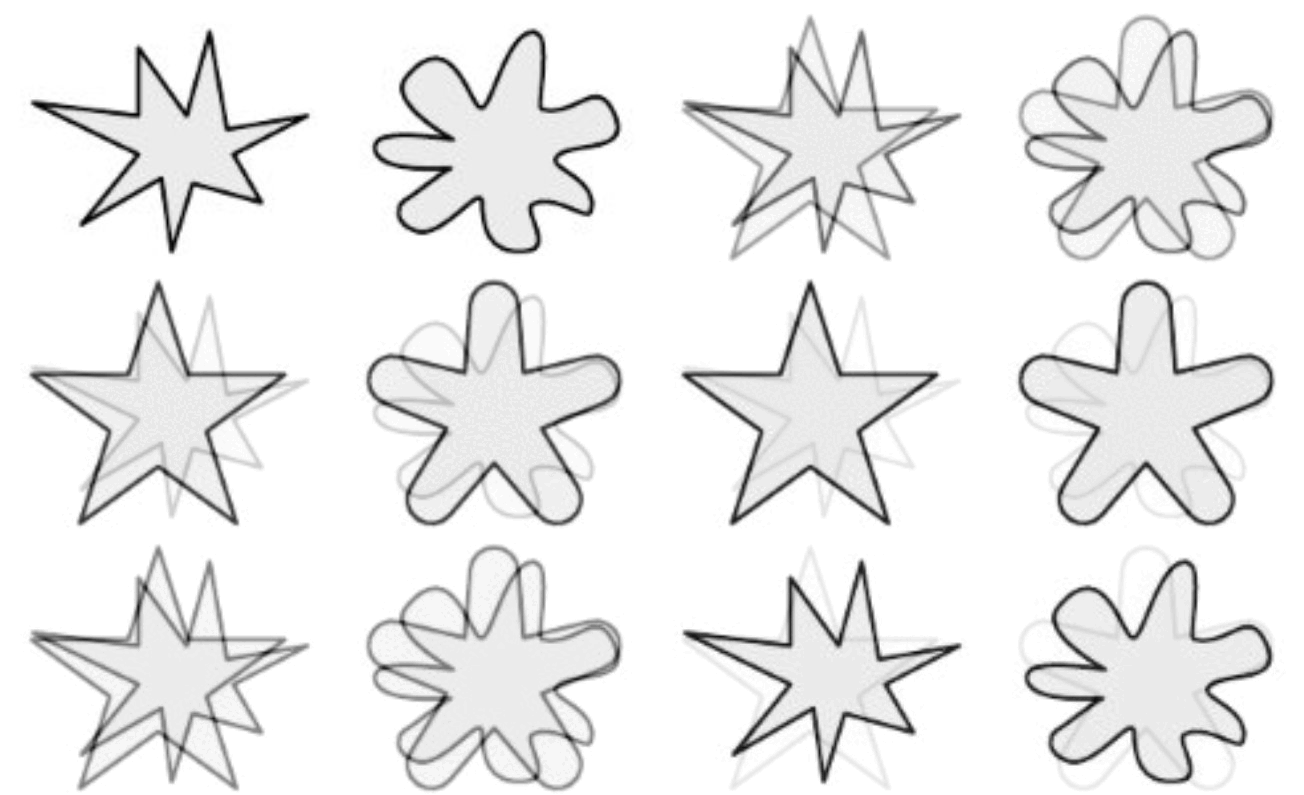
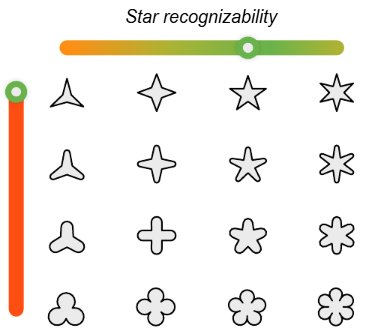
The star is a versatile shape, both in symbolism and visual representation. Stars can have a varied number of points while still being recognizable as a star. This is a rare quality among shapes and icons, as too much modification can easily change how a shape is recognized. Add another vertex to a square and it becomes a pentagon; remove one and it becomes a triangle. However, stars can have between four and six points (although five is the most common), while still being easily recognizable as a star
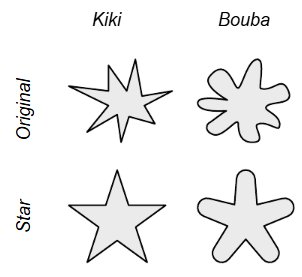
Furthermore, stars can be rounded while still being recognizable. This changes the “cacophony” of the symbol. An example of this is the famous "Kiki-Bouba" experiment, where participants identifies shapes with hard edges as “Kiki”, and softer shapes as “Bouba”. This characteristic allows stars to t a wide variety of music in album art without seeming out of place with the sound. Harsher, noisier songs fit with a sharp-edged stars. Softer songs fit with stars that have rounded edges.
Additionally, stars often represent a mark of quality. Five stars represents the highest rating a review can have on most shopping websites. Three Michelin stars is one of the most prestigious endorsements a high-end restaurant can receive. This carries over to music, as stars can implicitly hint that the music behind the album art is quality.
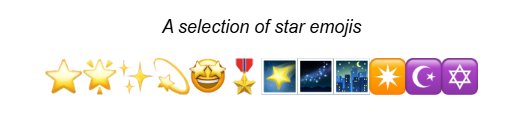
Stars also fit with the recent text-forward micrographics trend. Asterisks can be interpreted as stars under the right conditions. Additionally, with multiple stars being present in the emoji keyboard, the star is widely accessible as a symbol. This means stars can be used in raw text fields with the asterisk, or emoji text fields with a range of star emojis. This makes stars easy to use on social media sites outside of image fields, such as in the caption of a photo or inside of a tweet.
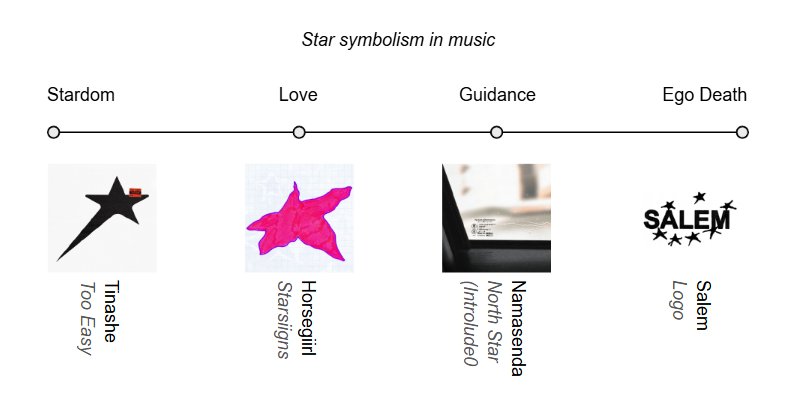
The musical symbolism of stars is also incredibly varied. Stars are commonly used as a symbol for stardom or fame. For example, a star is prominently displayed on the cover of Tinashe’s recent single “Too Easy,” an upbeat pop track centered around Tinashe’s success. In the song, Tinashe sings, “I know that I'm a superstar / And they hate to see I've come so far” over a minimal dance beat. These lyrics align with the star on the cover art in being a reflection of Tinashe’s stardom.
On the other end of the spectrum, stars can be used to provide a sense of cosmic scale, reminding us of how miniscule we are in the scheme of the universe. This is a common theme among the band Salem, whose music touches on themes of death, religion, and addiction. Lyrics such as “I would never claim no prophecy / 'Cause I know mans too small for it” (Red River), and “To their god, I asked him what he wants / And silence was the answer that I got” (Old Gods), use God as a metaphor to discuss the miniscule nature of human life in the scope of the universe.
Another unique example of star symbolism is found in Starsiigns by Horsegiirl. In the song, Horsegiirl sings about astrological compatibility between her and her lover: “I just need to know your star sign, star sign / Pisces or Leo, Taurus, I- / Gotta know if we align”.
Some other examples include the title of Namasenda’s track “north star (introlude)” references the north star as a guiding force, and Yung Lean's mixtape "Stardust", the title of which references how all matter comes from the stars.
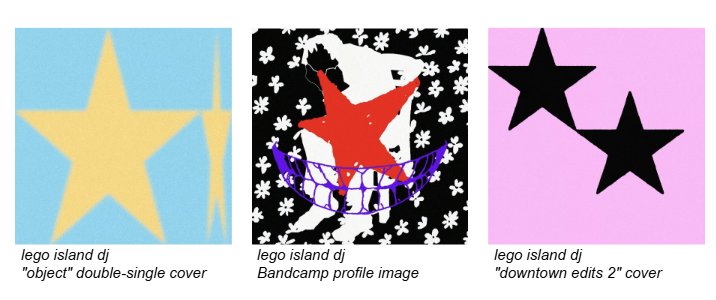
I spoke to some graphic designers and musicians on why they use stars in their work. Lego Island DJ, a musician and graphic designer who’s used stars in several of his designs, stated: “For me it’s kind of the first decorative shape you learn to draw as a kid, very naive and simple and pure… Kids get a gold star when they do well and it means ‘good’ and nothing else. I think I like to squish it and draw it imperfectly [because] it’s like a distortion of a simpler and better time”
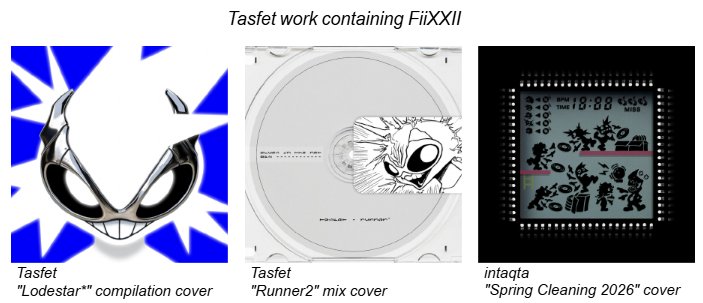
Tasfet, a musician and graphic designer, who current runs a record label named intaqta, stated: “My mascot is basically the personification of a star. the idea you can be your own guiding star, your own hero.” This mascot, named FiiXXII (pronounced fee-ksee), is present through much of Tasfet’s design work.
When asked if FiiXXII is a character or a representation of them, Tasfet said, “FiiXXII is not me, but they play with this idea I had as a kid of what a star or idol is…a presence that becomes larger than life and inspires. Something like Mario, Messi, or Michael Jackson… [W]hat they represent feels bigger than who or what they actually are. Literal stars, like the sun, are like that too if you think about it.
From a design perspective, FiiXXII is the experiment of making my very own lodestar, my own hero. A presence that is gonna be always there to look up to, no matter the place or date. No matter the challenges, I’ll know where north is for Tasfet.”
Stars have found a niche in music and graphic design, for their iconography and cultural symbolism alike. Their universal recognizability and already massive presence in media means the star symbol, like the stars in the sky, is unlikely to fade any time soon.
“We are the people that come from outer space
Built with stars, planets, astroplatforms and milky ways"